
1. Energy and power balance
A miner is a substantial continuous load. Cables, connection, protection, phase loading and available capacity must be designed accordingly. Control reduces or stops the load before unwanted grid import occurs.
Not every device can be modulated freely. Frequent hard switching can stress equipment, so manufacturer limits and interfaces are part of the design.
2. Recover heat professionally
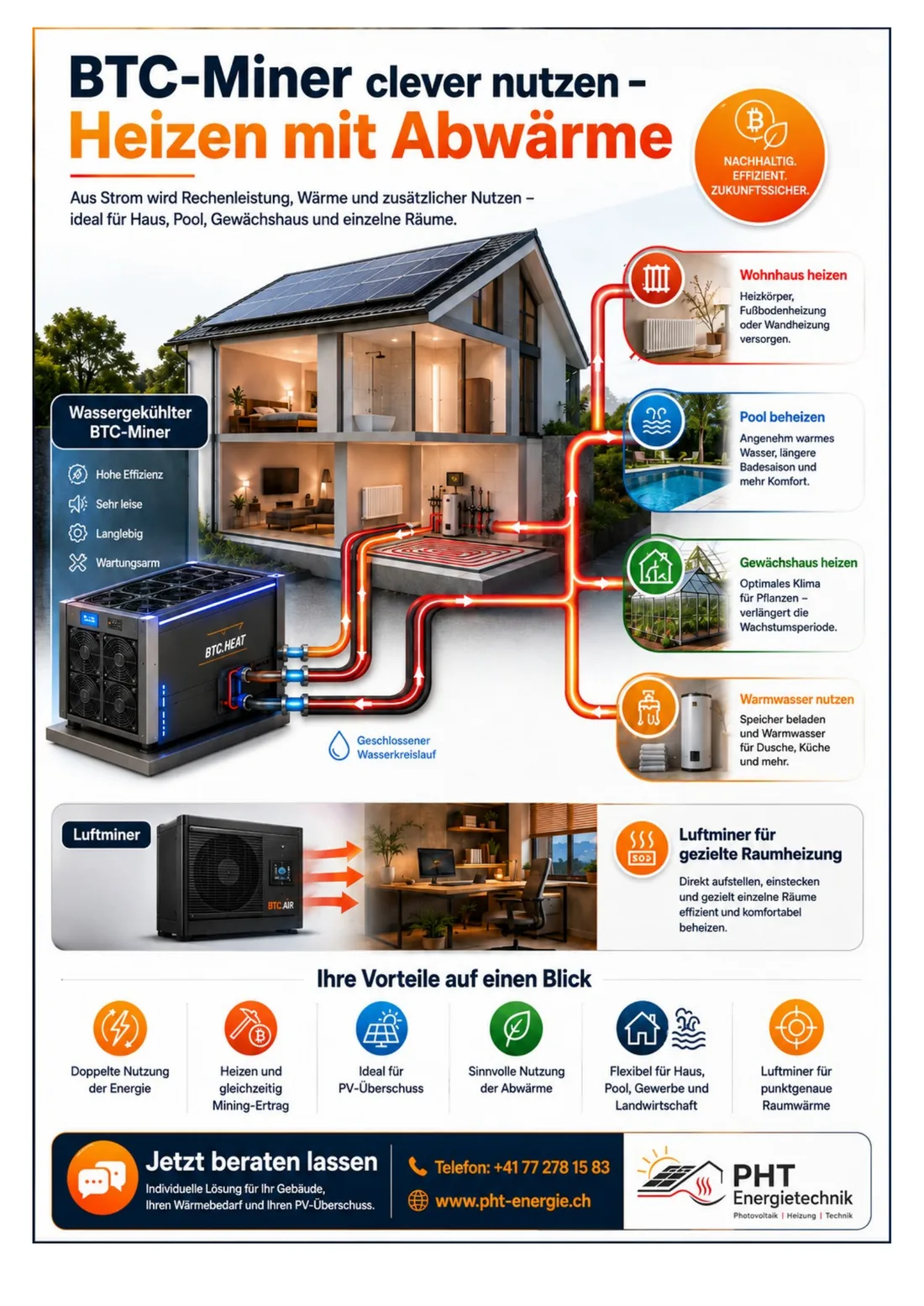
Almost all input power becomes heat. Air-cooled equipment provides heat at a relatively low temperature; liquid cooling can transfer it more effectively through a heat exchanger into a hydraulic circuit.
Heat has value only when it is needed at the same time. In summer, a lack of demand may require additional cooling and reduce the system benefit substantially.
- Measure temperature, flow and useful thermal output.
- Maintain hot-water hygiene requirements.
- Provide shutdown and heat rejection when the heat sink is unavailable.
3. Avoid optimistic economics
The model should separate lost export income, actually displaced heating cost, mining revenue and hardware cost. Maintenance, pool fees, any grid import, ventilation, tax and downtime also belong in the calculation.
Revenue depends on network difficulty, block rewards, fees, device efficiency and market value. None of these is guaranteed.
| Item | Include in the model |
|---|---|
| Electricity | PV opportunity cost plus any import |
| Heat | Only heat that actually displaces another source |
| Mining | Net revenue after operating costs |
| Hardware | Purchase, integration, cooling and residual value |
| Risk | Revenue change, failure, regulation and tax |
4. Safety, noise and operation
Mining equipment can create high sound levels, dust exposure and continuous heat. The room, air path, filters, fire protection, access and neighbours must be considered. Fixed electrical work belongs with appropriately qualified professionals.
The installation needs a safe shutdown for overheating, pump failure, communication errors or unavailable heat rejection.
5. When a technical review is worthwhile
A review is worthwhile where substantial recurring surplus, simultaneous heat demand and adequate space exist. With small surplus or no heat use, batteries, heat pumps, EV charging or export are usually more direct options.
PHT assesses the technical integration. It does not provide investment, tax or legal advice and does not guarantee returns.
- Annual and daily surplus profile
- Monthly heat demand and temperature level
- Connection capacity and distribution board
- Noise and cooling concept
- Tax and contractual review
Sources and data date
- Federal Inspectorate for Heavy Current Installations ESTI – electrical safety
- Swiss Federal Tax Administration SFTA – tax information on crypto assets
- Swiss Federal Electricity Commission ElCom – electricity prices and market information
Updated: 12.07.2026. Always verify current tariffs, incentives, regulations and mining values before making a decision.

Patrick Prünster
Your personal contact for solar PV, storage, heat pumps, control technology and energy optimisation.
More about Patrick Prünster →